
Connect Fest Burnaby was a free, city-wide community festival that ran every spring from 2016 to 2024 – five days, four neighbourhoods, hundreds of events organized by residents themselves. If you were there, a workshop in a school gym, a poetry walk along Stoney Creek, a storytelling circle over tea in Edmonds, you know what made it different. We were there too. Here is what it was, how its event grants worked, and which free festivals are still running in the region today, in 2026.
Note: This is an independent fan site. We attended Connect Fest as members of the community, not as organizers or affiliates. We have no connection to SFU, the City of Burnaby, or the former festival team.
What Connect Fest Was
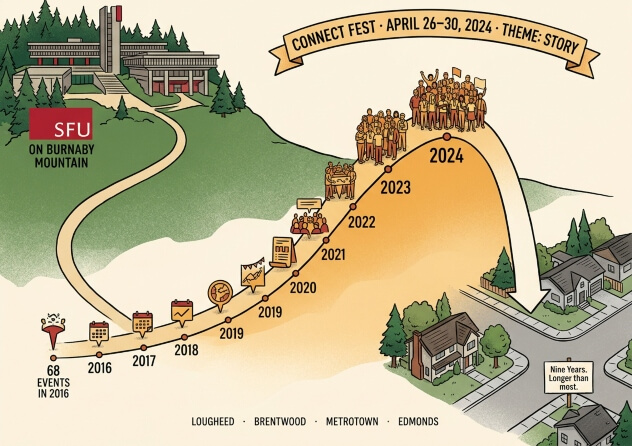
In 2016, Simon Fraser University and the City of Burnaby launched the Burnaby Festival of Learning. The model was borrowed from a grassroots event in Cork, Ireland. SFU would “come down from the mountain”, the university’s Burnaby Mountain campus, and co-produce a city-wide event with local residents. That first year brought 68 events. Free, community-organized, open to everyone.
The festival grew annually. By 2022, it involved 100-plus event organizers and 30 community organizations. In February 2024, it was renamed Connect Fest. The rebranding reflected what the event had always been: less a learning program, more a gathering. The name change lasted four months.
The last Connect Fest ran April 26–30, 2024. Theme: Story. Five days, four neighbourhood quadrants, programming in Burnaby’s Lougheed, Brentwood, Metrotown, and Edmonds areas. Then it was over.
Nine years. That is a longer run than most community-university partnerships manage. Most dissolve within three.
The Event Grant Program
Connect Fest funded community events directly. Up to $1,500 per project, $20,000 total available for the 2024 edition. Applicants submitted a simple budget outline — time, materials, gear rentals, elder transportation. The City of Burnaby provided community spaces and marketing. Organizers supplied the knowledge.
That combination was unusually practical. Most event grant programs in BC require multi-page applications, formal organizational status, and six-month timelines. Connect Fest event grants worked faster. A resident with an idea and a community space could have funding confirmed within weeks.
The maximum award, $1,500, sounds small. But for a storytelling workshop, a walking tour, or a one-day food event, $1,500 covers almost everything. That is the size of event Connect Fest was built around. Workshops in school gymnasiums and library meeting rooms. Not ticketed productions.
The grant program is gone. What exists in 2026: the City of Burnaby’s Community Development Grants (larger amounts, longer timelines, more documentation), the BC Arts Council Community Arts stream, and SFU’s Office of Community Engagement, which still funds partnerships on a project basis but without a public application cycle.
The Four Neighbourhood Quadrants
Connect Fest Burnaby distributed its programming across four geographic zones. This was deliberate. Instead of concentrating everything in one venue, events happened where people already lived.
The Northeast Quadrant (Lougheed) sat closest to SFU’s Burnaby campus and the SkyTrain terminus. Most SFU-affiliated events landed here: the archaeology department’s Exploration Day, the Child Research Group workshops, the SFU Café Scientifique sessions. The Northwest (Brentwood) used Willingdon Community Centre as its main hub. Southwest (Metrotown) ran larger-scale events at Deer Lake Park and adjacent venues. Southeast (Edmonds) was the most diverse zone: Edmonds Community School hosted a full-day event in 2024 featuring food from five cultural communities, collaborative mural work, and dance performances.
For the 2024 edition specifically, Edmonds was where the program felt most concentrated. The Long Table Society, a Burnaby organization that combats food insecurity through community dining, hosted its Flavours of Edmonds event as part of the festival. That organization is still active. Its programming continues independently.
Why Did the Fest Close?
SFU and the City of Burnaby issued a short statement. Budget pressure. Difficult decisions. No alternative announced.
No public breakdown of the financials was released. The most likely factor: both institutions were managing significant post-pandemic budget constraints in 2024–2025. The festival ran on a modest budget relative to its reach, $20,000 in direct event grants plus staff time, but staff time is what large institutions cut first.
What is not publicly documented: whether any community organization attempted to take the festival over independently. The domain lapsed. The official site went dark in early 2025. That’s all that’s on record.
It’s a loss we still feel. Something that brought 100-plus organizers and 30 community organizations together every spring – for free, across four neighbourhoods – doesn’t just get replaced by a calendar link. We checked.
Four Events That Made the List
That said, we spent time looking. If Connect Fest is gone, we at least wanted to know what’s still out there, events worth showing up to, in Burnaby and close enough to matter. Here is what made the list.
StrideFest – March 21–28, 2026
North Burnaby / Hastings Heights · Free
Organized by the Long Table Society, the same organization that ran events at Connect Fest in 2024. Art in unexpected places, free, no arts background required. The closest thing to what Connect Fest was doing in the Heights area.
Hats Off Day – June 6, 2026
Hastings Street, Burnaby Heights · Free
60,000 people attend annually, more than Connect Fest’s total reach across all five days combined. Theme this year: Under the Big Top. Parade, car show, five stages, family events.
Powell Street Festival – August 1–2, 2026
Oppenheimer Park, Vancouver DTES · Free
The festival turns 50 in 2026. Japanese Canadian arts and culture, 23,000-plus attendees, same park it’s been in since 1977. A 50th anniversary exhibition is already open at the Nikkei National Museum in Burnaby through September 5.
Festival du Bois – Next edition March 2027
Mackin Park, Coquitlam · Friday free, weekend ticketed
BC’s largest Francophone festival wrapped its 37th edition in March 2026. Same park, same weekend, same community since 1990. Worth planning for next year.
→ Full reviews, dates, transit info, and more free events in Burnaby for 2026
Frequently Asked Questions
Connect Fest ran its final edition in April 2024. SFU and the City of Burnaby cited financial constraints and closed the program. The official website went offline in early 2025. No revival has been announced.
The Burnaby Festival of Learning was the original name of Connect Fest. It launched in 2016 as a co-production between SFU’s Office of Community Engagement and the City of Burnaby. In February 2024 it was renamed Connect Fest. The 2024 edition was the last.
The grant program awarded up to $1,500 per event, with $20,000 total available in 2024. Applicants submitted a simple budget. The City of Burnaby provided community spaces and marketing. Applications closed December 15, 2023, for the 2024 edition.
Lougheed is in Burnaby’s Northeast Quadrant. It borders the SFU Burnaby campus and includes the Lougheed SkyTrain station. Connect Fest ran programming here every year, including SFU department events and community science workshops.
Burnaby Civic Square (adjacent to City Hall in Metrotown) was one of the anchor venues for the Southwest Quadrant programming. Several Connect Fest events used the Civic Square and the surrounding Deer Lake Park area across the festival’s nine-year run.